

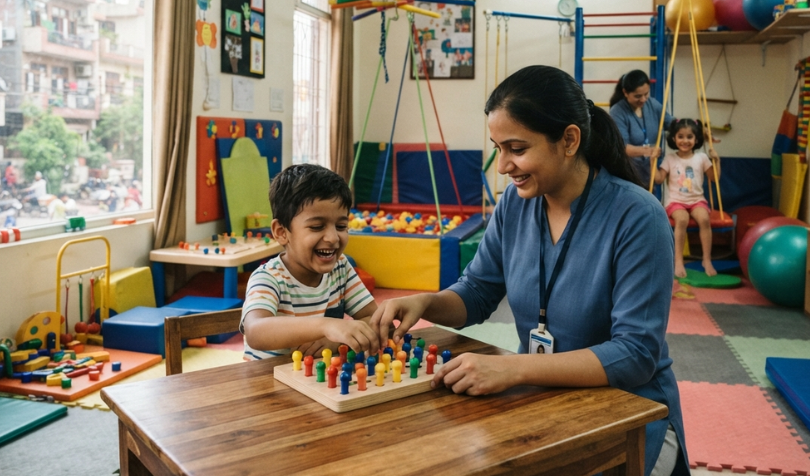
Occupational Therapy Centre in East Delhi
Professional Pediatric Occupational Therapy in East Delhi
Looking for a trusted Occupational Therapy Centre in East Delhi for your child? Our pediatric occupational therapy services are designed to help children develop the functional skills they need for everyday life, school, play, self-care, and greater independence.
Children develop at different rates, and some may need additional support with fine motor skills, gross motor coordination, sensory processing, handwriting, attention, self-care, motor planning, or developmental skills.
Our approach focuses on understanding each child's individual strengths, challenges, abilities, and everyday needs. Based on the assessment, we create a personalized occupational therapy program using structured, engaging, and age-appropriate activities.
The aim is to help children participate more comfortably and confidently in activities at home, school, and in their community.
What Is Occupational Therapy?
Occupational Therapy (OT) helps children develop skills required to participate in meaningful everyday activities.
Pediatric Occupational Therapy Centre in East Delhi
Our occupational therapy services are designed for children who experience difficulties that affect their daily functioning or participation.
Our Occupational Therapy Services
4. Occupational Therapy for Autism
Fine motor skills involve the small muscles of the hands and fingers. These skills are important for writing, drawing, eating, dressing, and playing.
2. Gross Motor Skills Therapy
Gross motor skills involve larger body movements and whole-body coordination.
3. Sensory Integration & Sensory Processing Support
Some children may experience difficulty responding to sensory information such as sounds, touch, movement, textures, lights, or body sensations.
4. Occupational Therapy for Autism
Children with autism may experience differences in sensory processing, motor coordination, play, self-care, attention, and participation in everyday activities.
Occupational therapy may support areas such as:
OT can form one component of a broader individualized support plan and may be coordinated with other professionals when appropriate.
5. Occupational Therapy for ADHD
Children with ADHD may experience difficulties related to attention, activity level, impulsivity, organization, coordination, or task completion.
6. Developmental Delay Therapy
Developmental delays can affect a child's ability to perform age-appropriate activities.
7. Handwriting Therapy
Handwriting difficulties can affect a child's classroom participation and academic confidence.
8. Activities of Daily Living (ADL) Training
A key goal of pediatric occupational therapy is helping children become more independent in everyday activities.
9. School Readiness Therapy
Starting school requires children to manage new routines, classroom activities, motor tasks, and self-care responsibilities.
10. Visual Motor Integration Therapy
Visual-motor integration involves coordinating visual information with hand movements.
11. Motor Planning & Coordination Therapy
Motor planning helps children organize and perform movements.
12. Attention & Concentration Activities
Some children have difficulty remaining engaged in age-appropriate activities.
Occupational Therapy for Cerebral Palsy
Children with cerebral palsy may experience difficulties involving movement, coordination, hand function, posture, and independence.
Occupational Therapy for Down Syndrome
Children with Down syndrome may benefit from support with motor development, coordination, self-care, school readiness, and functional independence.
Feeding & Self-Care Support
Some children may have difficulties with feeding routines or self-care activities.
Who Can Benefit From Occupational Therapy?
An occupational therapy consultation may be appropriate for children experiencing:
Signs Your Child May Need Occupational Therapy
Parents may consider an OT consultation if their child regularly has difficulty with:
Course Features
- Start Date: 24 March 2024
- Years old: 04 - 06 years
- Class Size: 20 - 30 kids
- Carry time: 01 hours / 02 hours
- Class Duration: 10 - 12 month
- Class time: 09:00am - 6:00pm
- Rating:
- Tution Fee: 2500.00